Danièle Huillet’s and Jean-Marie Straub’s Moses und Aron (1975) is the duo’s dialectical masterpiece. Their joint career was spent exploring the limitations of the cinema and mapping out its possibilities. Their films about music, such as Moses und Aron, were amongst their most fruitful exercises in formalism. As much as Moses und Aron reflexively analyses the cinema and Arnold Schoenberg’s opera, it also challenges the very notion of faith.
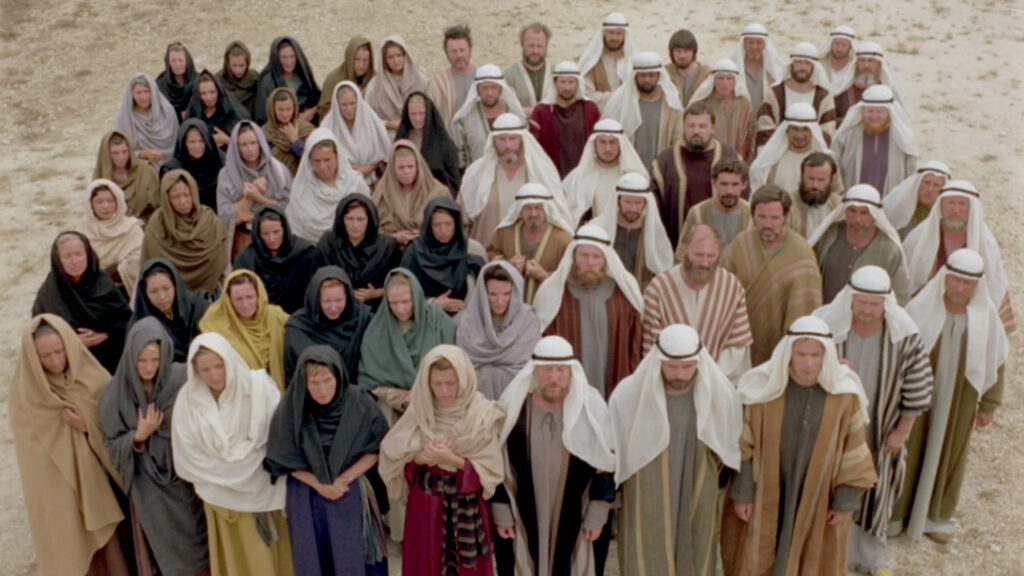
Straub and Huillet construct their images matter-of-factly. Moses (Günter Reich), Aron (Louis Devos), the Children of Israel (chorus), etc. are all posed statuesquely in primarily still shots from dynamic angles for a long duration (in both shots and scenes). Cinematic technique is employed minimally to accentuate the fundamental nature of the images within the complex of the montage. This imbues the images with a very material quality akin to photographs.
The material nature of the images mirrors the physicality represented by Aron in opposition to Moses’ immateriality and intellectualism. Within the dichotomy of these two cousins is the paradox of faith itself between belief and proof. The inherent conflict of faith is what makes Moses’ role as a revolutionary so difficult. However, Straub and Huillet have a means of rectifying the two within the nature of the relationship between sound and image. Arnold Schoenberg’s music becomes representative of the power of belief whilst the images of Moses und Aron represent the proof of that belief.
All at once Straub and Huillet have managed to address the fundamental crisis of Judeo-Christian belief while simultaneously defining the ultimate power of the cinema: to tangibly render faith. Yet Moses und Aron isn’t a film of great piety in the traditional sense. The faith of Straub and Huillet is in the practical implementation of the cinema.
