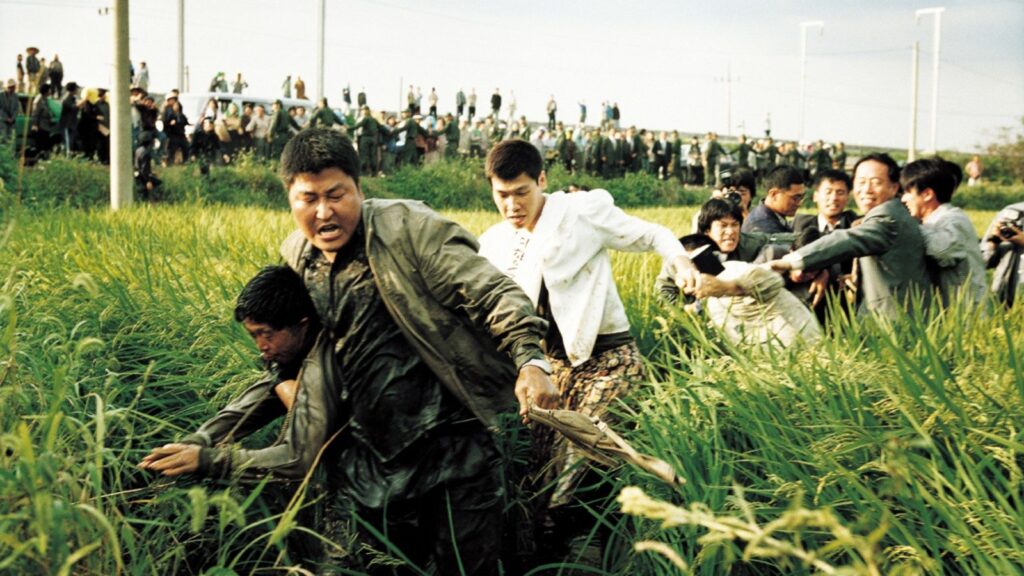
Memories Of Murder (2003) was Bong Joon-ho’s breakout feature. Only his second feature, Memories Of Murder is a sophisticated film with an intricate narrative and a mature sense of stylization. The film is a largely fictitious account of the Lee Choon-jae murders. Memories Of Murder is a police procedural, leaving the true culprit off camera until the final act of the film.
Detective Park Doo-man (Song Kang-ho) and Seoul Detective Seo Tae-yoon (Kim Sang-kyung) are heading up the investigation in rural Hwaseong. Their methods vary from Dirty Harry (1971) style tortures to more honorable “by the book” tactics. Bong Joon-ho is careful to remain objective as possible in how these characters are portrayed and captured on film. The police in Memories Of Murder are equal parts villainous and righteous. This contradiction gets to the heart of the intrinsic problem within mankind; the fact that an instinctual reaction is often at odds with justice and civilized morality. The question here, specifically, is do the ends justify the means?
Bong Joon-ho also realizes that if his policeman are to appear as flawed and conflicted human beings then it is important that they also be funny. There are a number of humorous one-liners throughout Memories Of Murder, but the real comic relief comes about midway through the film when Det. Park Doo-man has an idea. He proposes that since the killer has failed to leave behind any pubic hair at the scene of the crime than he must be shaving his genital region. So, the dutiful cop that he is, Det. Park Doo-man goes to a local bath house to scope out the pubic hair situation of the locals. Bong Joon-ho gives us a nice little montage of this that is probably the funniest thing I have ever seen in a serious cop picture.
Lee Choon-jae’s crimes were atrocious. The brutality of these acts, even though Bong Joon-ho never shows them on screen, make it difficult to condemn those set with the task of apprehending the criminal. We see these detectives change, one becomes more moral while the other does the opposite, in the face of these crimes. The tragedy in Memories Of Murder is that the savage force used by the police doesn’t stop the killings. The system is flawed, the people are flawed, and by the end nothing is all that certain beyond the acceptance of that cold ambiguity.
