
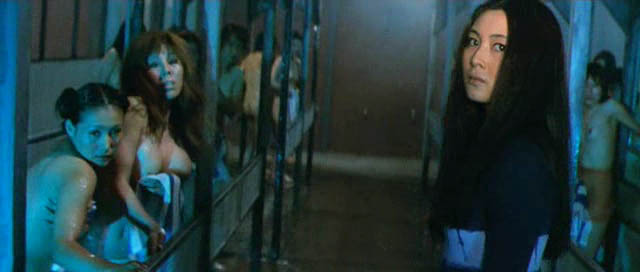
Shunya Itō’s film Female Prisoner 701: Scorpion (1972) is one of the greatest exploitation films ever made. Unlike so many films of this kind, Female Prisoner 701: Scorpion (and its first two sequels) is totally deserving of its reputation and enduring popularity. Female Prisoner 701: Scorpion gave the legendary Meiko Kaji one of her most iconic roles as the title character of this rape/revenge and women in prison hybrid film.
What makes Female Prisoner 701: Scorpion such an extraordinary piece of genre filmmaking is the aesthetic fusion of avant-garde theater, Pop Art, and cinematic expressionism that Shunya Itō brings to the film. In a scene where Kaji’s character, tied up in solitary confinement, has a flashback to the ill fated love affair that landed her in prison Itō employs revolving sets, body doubles and carefully hidden cuts to create in frame a physical space as fluid as the temporal space within the character’s memory. In a similar fashion the sequence where the prisoners riot suddenly goes from an exterior location shot to an interior soundstage on a set that is as dynamic and painterly as anything in An Actor’s Revenge (1963).
These are the moments where Female Prisoner 701: Scorpion transcends all genres and enters the realm of pure cinematic art. In the many scenes between these expressive set pieces Itō employs a visual style consisting of slanted angles, intense close-ups, and non-diegetic light sources that recall the mid-sixties films of Seijun Suzuki as well as comic books. The world of Female Prisoner 701: Scorpion is one elaborate complex of images that with every stroke conveys the emotional content of the scene as well as a reflexive commentary on the aesthetic lineage of the dramatic moment being recorded.
Female Prisoner 701: Scorpion is replete with symbols, though none are as potent or meaningful in the film as that of the Japanese flag. Itō introduces the hinomaru as the first image of Female Prisoner 701: Scorpion. The flag waves in the wind high above the prison. It’s a patriotic image that, when next glimpsed, is totally subverted. When the hinomaru is next seen it is as a blood stain on white sheets in the flashback to when Kaji’s character lost her virginity. In the scene where the hinomaru is seen next and for the final time, it is when Kaji’s character has completed her revenge. In the throws of death, the dying man throws his gun into the air, sending it right passed the flag. The hinomaru’s meaning in the film evolves just as its wider political significance de-evolves. The flag goes from patriotic object to a symbol of patriarchal oppression to being a metaphor for masculine death.
This symbolism indicates the political and social modus operandi of Female Prisoner 701: Scorpion and the subsequent films in the series directed by Shunya Itō. The Kaji character, Matsu the Scorpion, is more a symbolic figure of resistance and survival within a patriarchal culture. All of the women in this film are prisoners or servants to the police or the yakuza. Both institutions are male dominated and enemies of Matsu. In Female Prisoner 701: Scorpion it is Matsu’s strength of will that combats and ultimately destroys those who have imprisoned her.
Female Prisoner 701: Scorpion, the first film in the series, is very much about Matsu learning to live with her trauma via vengeance. Once that is realized and she is again incarcerated the next film is free to deal with fighting patriarchal oppression through female solidarity and unity. The third film (and my personal favorite), Female Convict Scorpion: Beast Stable (1973), is a metaphor for creating and sustaining female centered communities in defiance of a patriarchal culture. Needless to say the progressive political messaging of these films is a major component to their endured popularity.
What Itō does in his Female Prisoner: Scorpion films that differs from most rape/revenge films on a fundamental level is that he never assumes his film can create anything comparable to the “female experience”. Where other rape/revenge films get tied up in the despicable details of violence and trauma as a sexualized spectacle, Itō prefers to focus only on the emotions of these scenes. Sexual violence is rendered in expressive gestures, dramatic light changes, color, bizarre camera angles, and harsh percussive music cues. Itō attempts to remove the “sex” from sexual violence and replace it with the interior emotionality of the character in broad, generalized strokes.
Essentially what this strategy does for Itō is to keep his Female Prisoner: Scorpion films abstract. As charismatic as Kaji is, Matsu is not much of an idiosyncratic character. In Itō’s hands Matsu is a political symbol or caricature. The Female Prisoner: Scorpion films are political theater in the true Brechtian sense. On a superficial level these films titillate like any other exploitation movie, but beneath that veneer is a political agenda brimming with rage.
